GWA Grading System Explained: How Philippine Universities Calculate Grades
Understanding the GWA grading system is crucial for every Filipino college student. This guide explains how Philippine universities calculate grades, how to interpret common equivalent values such as 1.46, 1.49, 1.51, and 1.74, and how those numbers affect honors, academic standing, and planning.
What is the GWA Grading System?
The General Weighted Average (GWA) grading system is the standardized method used by Philippine colleges and universities to evaluate student academic performance. Unlike simple averaging, GWA considers both your grades and the credit units of each subject, providing a more accurate representation of your academic achievement.
The GWA system helps schools summarize weighted academic performance across subjects and credit units, making it easier for students, registrars, scholarship offices, and employers to review college records. For official higher education policy context, consult the Commission on Higher Education and your university registrar.
Key Insight
The GWA system ensures that subjects with more credit units have greater impact on your overall academic standing. A 3-unit subject affects your GWA three times more than a 1-unit subject.
Standard Philippine University Grading Scales
Philippine universities primarily use two main grading systems: the 5.0 scale and the 4.0 scale. Understanding these scales is essential for calculating your GWA accurately.
The 5.0 Grading Scale (Most Common)
The majority of Philippine universities, including the University of the Philippines system, use the 5.0 grading scale where 1.0 is the highest grade and 5.0 is failing.
| Grade | Percentage Equivalent | Description | Quality Points |
|---|---|---|---|
| 1.00 | 96-100% | Excellent | 4.0 |
| 1.25 | 94-95% | Superior | 3.7 |
| 1.50 | 91-93% | Very Good | 3.3 |
| 1.75 | 89-90% | Good | 3.0 |
| 2.00 | 86-88% | Very Satisfactory | 2.7 |
| 2.25 | 83-85% | High Average | 2.3 |
| 2.50 | 80-82% | Average | 2.0 |
| 2.75 | 77-79% | Fair | 1.7 |
| 3.00 | 75-76% | Pass | 1.0 |
| 5.00 | Below 75% | Failing | 0.0 |
Common GWA Equivalent Examples Students Search For
Many students do not search for the full grading system first. Instead, they search for a specific value such as 1.46 GWA equivalent or 1.74 GWA equivalent to understand what their standing means. These lookups are directional, because each school can publish slightly different percentage mappings and honors cutoffs.
The table below is meant for interpretation, not official certification. Use it to understand the likely academic meaning, then confirm the exact percentage, honors cutoff, or scholarship requirement with your registrar or handbook.
Quick answer: what does a 1.46 GWA equivalent usually mean?
A 1.46 GWA equivalent is usually a very strong college result on a Philippine 1.00 to 5.00 scale, often interpreted around the low-90s percentage range in unofficial reference tables. It can sit close to Latin honors cutoffs at some schools, but the exact meaning depends on whether your university uses 1.45, 1.50, 1.75, or another boundary for awards and retention checks.
| GWA Value | Typical Interpretation | Approximate Percentage | Student Use Case |
|---|---|---|---|
| 1.46 GWA equivalent | Strong standing, often near Magna/Cum Laude boundary | Usually around 91-93% | Check honors eligibility and scholarship retention |
| 1.49 GWA equivalent | Very strong overall result | Usually around 91-93% | Compare against honors cutoffs and dean's list rules |
| 1.51 GWA equivalent | Good to very good standing | Often around 88-90% | Estimate if one more high-grade term can improve honors status |
| 1.74 GWA equivalent | Solid academic performance | Often around 88-90% | Review program rules before assuming honors status |
| 2.00 GWA equivalent | Above passing and commonly viewed as very satisfactory | Often around 85-87% | Useful for checking minimum scholarship or program retention grades |
| 3.00 GWA equivalent | Usually the lowest passing area on many 5.00 scales | Often around 75% | Check retake, probation, or minimum grade rules in your school |
If you want a quick value-by-value interpretation, use the GWA Equivalent Calculator. If you want to understand why your number lands in a given range, continue with the grading-system explanation below.
Which page should answer which search?
Use this article for broad questions about the GWA grading system, grade scales, honors rules, and how Philippine universities calculate weighted averages. Use the GWA Equivalent Calculator for exact value lookups such as 1.46, 1.57, 1.75, or 2.00 GWA equivalent. This keeps calculation, interpretation, and grading-system explanation separate and easier to trust.
How to interpret close GWA equivalent values
Small differences such as 1.45, 1.46, 1.49, and 1.50 can matter when a school uses strict honors or scholarship thresholds. Treat these values as boundary checks rather than as universal percentage conversions.
| Student search | Best action | Why it matters |
|---|---|---|
| 1.46 GWA equivalent | Check the honors table and registrar scale | Often near a boundary, so one decimal rule can change the interpretation |
| 1.49 or 1.50 equivalent | Compare against the exact cutoff used by your school | Some schools round differently; others apply the listed value directly |
| 1.75 equivalent | Review whether the cutoff is for semester, cumulative, or graduation GWA | The same number can mean different things for dean's list, Latin honors, or retention |
The 4.0 Grading Scale
Some universities, particularly private institutions like De La Salle University and FEU-East Asia College, use the 4.0 scale where 4.0 is the highest grade.
| Grade | Percentage Equivalent | Description | Letter Grade |
|---|---|---|---|
| 4.0 | 96-100% | Excellent | A+ |
| 3.5 | 91-95% | Very Good | A |
| 3.0 | 86-90% | Good | B+ |
| 2.5 | 81-85% | Satisfactory | B |
| 2.0 | 76-80% | Fair | C |
| 1.0 | 75% | Pass | D |
| 0.0 | Below 75% | Failing | F |
How GWA Calculation Works: Step-by-Step Process
Calculating your GWA involves a weighted average formula that considers both your grades and credit units. Here's the detailed process:
The GWA Formula
GWA Formula
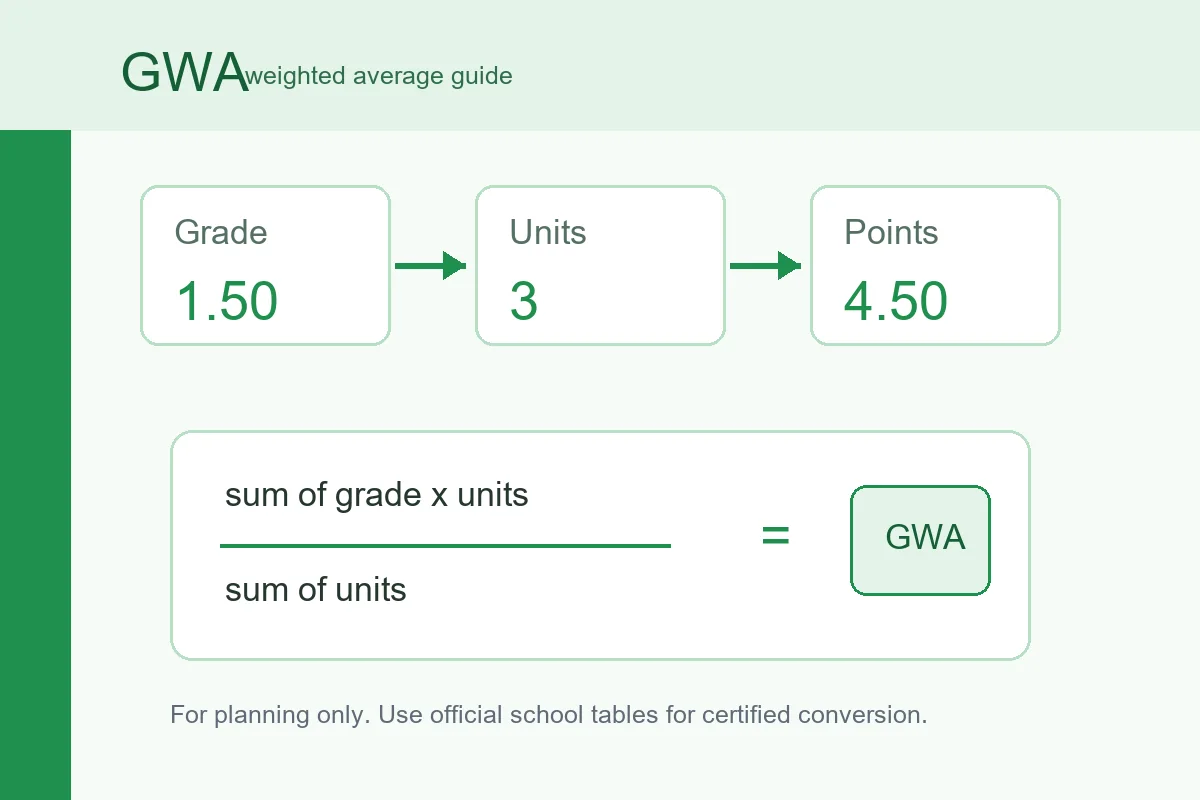
GWA = Σ(Grade × Credit Units) ÷ Σ(Credit Units)
Where Σ represents the sum of all subjects taken.
Step-by-Step Calculation Example
Let's calculate the GWA for a student with the following grades:
| Subject | Grade | Credit Units | Grade × Units |
|---|---|---|---|
| Mathematics | 1.50 | 3 | 4.50 |
| English | 1.75 | 3 | 5.25 |
| Science | 2.00 | 4 | 8.00 |
| History | 1.25 | 3 | 3.75 |
| PE | 1.00 | 2 | 2.00 |
| Total | - | 15 | 23.50 |
GWA Calculation: 23.50 ÷ 15 = 1.567 (rounded to 1.57)
This GWA of 1.57 falls under "Very Good" performance in the 5.0 grading scale.
University-Specific GWA Systems
While most Philippine universities follow similar grading principles, each institution may have specific variations in their GWA calculation methods.
University of the Philippines (UP) System
The UP system uses the standard 5.0 scale with some unique features:
- Weighted Average: Uses the standard GWA formula
- Academic Standing: Requires minimum 2.0 GWA for good standing
- Latin Honors: Summa Cum Laude (1.20), Magna Cum Laude (1.45), Cum Laude (1.75)
- Special Grades: INC (Incomplete), DRP (Dropped), P (Passed)
According to Scholaro's grading database, UP Diliman follows a 1.00 to 5.00 style scale that many students use as a reference point when comparing Philippine grade equivalents.
Ateneo de Manila University
Ateneo uses a modified 4.0 scale with letter grades:
- A (4.0): 93-100% - Excellent
- B+ (3.5): 87-92% - Very Good
- B (3.0): 80-86% - Good
- C+ (2.5): 75-79% - Satisfactory
- C (2.0): 70-74% - Fair
- D (1.0): 65-69% - Conditional
- F (0.0): Below 65% - Failing
De La Salle University
DLSU employs a 4.0 scale with term-based GWA calculation:
- Cumulative GWA: Considers all terms completed
- Term GWA: Calculated per academic term
- Dean's List: Requires minimum 3.5 GWA with no grade below 2.5
- Academic Probation: GWA below 2.0
Academic Standing Classifications
Philippine universities use GWA to determine academic standing, which affects scholarship eligibility, graduation honors, and academic probation status.
Academic Standing Categories (5.0 Scale)
| GWA Range | Academic Standing | Status | Implications |
|---|---|---|---|
| 1.00 - 1.20 | Summa Cum Laude | Highest Honors | Graduation with highest distinction |
| 1.21 - 1.45 | Magna Cum Laude | High Honors | Graduation with high distinction |
| 1.46 - 1.75 | Cum Laude | Honors | Graduation with distinction |
| 1.76 - 2.00 | Good Standing | Excellent | Eligible for scholarships and leadership roles |
| 2.01 - 2.50 | Good Standing | Satisfactory | Regular academic progress |
| 2.51 - 3.00 | Good Standing | Fair | May need academic support |
| Above 3.00 | Academic Probation | Warning | Risk of dismissal, mandatory counseling |
Factors Affecting GWA Performance
Understanding what influences your GWA helps you develop effective strategies for academic improvement.
Credit Unit Distribution
Major subjects typically carry more credit units, making them more impactful on your GWA:
- Major Subjects: 3-6 credit units (highest impact)
- Minor Subjects: 2-3 credit units (moderate impact)
- Electives: 1-3 credit units (variable impact)
- Laboratory/PE: 1-2 credit units (lower impact)
Grade Consistency vs. High-Impact Subjects
Strategic Insight
A single excellent grade (1.00) in a 6-unit major subject has the same GWA impact as six excellent grades in 1-unit subjects. Focus your efforts on high-credit subjects for maximum GWA improvement.
Common GWA Calculation Mistakes
Many students make errors when calculating their GWA manually. Here are the most common mistakes to avoid:
1. Simple Average Instead of Weighted Average
Wrong: Adding all grades and dividing by number of subjects
Correct: Multiplying each grade by its credit units, then dividing by total credit units
2. Including Non-Credit Courses
Some courses like NSTP, remedial classes, or audit courses may not count toward GWA calculation. Check your university's specific policies.
3. Incorrect Handling of Incomplete Grades
INC, DRP, and other special grades require specific treatment according to university policies. They may be excluded from GWA calculation or assigned specific values.
4. Mixing Different Grading Scales
When transferring between universities, ensure proper grade conversion between different grading scales (5.0 to 4.0 or vice versa).
Strategies to Improve Your GWA
Improving your GWA requires strategic planning and consistent effort. Here are proven methods used by successful Filipino students:
1. Prioritize High-Credit Subjects
Focus extra study time on subjects with the most credit units. A 0.25 improvement in a 6-unit subject has more GWA impact than a 0.50 improvement in a 2-unit subject.
2. Maintain Consistent Performance
Steady grades across all subjects often yield better GWA results than excelling in some subjects while failing others.
3. Strategic Course Selection
- Choose electives in your areas of strength
- Balance difficult and manageable subjects each semester
- Consider professor ratings and teaching styles
- Plan prerequisite sequences carefully
4. Academic Support Resources
- Tutoring Services: Many universities offer free peer tutoring
- Study Groups: Collaborate with classmates for better understanding
- Professor Office Hours: Utilize faculty consultation time
- Academic Advisors: Get guidance on course planning
GWA vs. GPA: Understanding the Difference
Many students confuse GWA with GPA (Grade Point Average). While both measure academic performance, they have key differences:
| Aspect | GWA (Philippines) | GPA (International) |
|---|---|---|
| Scale | 5.0 or 4.0 (varies by institution) | Primarily 4.0 |
| Highest Grade | 1.0 (5.0 scale) or 4.0 (4.0 scale) | 4.0 |
| Calculation | Weighted by credit units | Weighted by credit hours |
| Usage | Philippine higher education | International applications |
For international applications, you may need to convert your GWA to GPA using official conversion tables or credential evaluation services. If you only need to understand a local grade value such as 1.46, 1.57, or 1.75, use the GWA Equivalent Calculator for percentage ranges and grade meanings.
Technology Tools for GWA Management
Modern students can leverage technology to track and improve their GWA performance:
Digital GWA Calculators
Online calculators like our GWA Calculator provide instant, accurate GWA computation with features like:
- Multiple grading scale support
- Semester-by-semester tracking
- Grade prediction scenarios
- Academic standing indicators
Mobile Apps and Spreadsheets
Many students use mobile apps or create Excel spreadsheets to monitor their academic progress throughout the semester.
Future Trends in Philippine Grading Systems
The Philippine higher education landscape continues evolving, with several trends affecting GWA systems:
Standardization Efforts
CHED (Commission on Higher Education) continues working toward greater standardization across institutions, making grade transfers and comparisons more seamless.
Digital Transcripts
Universities are adopting digital transcript systems that automatically calculate GWA and provide real-time academic standing updates.
Competency-Based Assessment
Some institutions are exploring competency-based grading that focuses on skill mastery rather than traditional letter grades.
Regional Variations in GWA Systems
While the Philippines follows general grading standards, regional universities may have specific adaptations based on local educational needs and international partnerships.
Metro Manila Universities
Universities in the National Capital Region often follow stricter grading standards due to higher competition and international accreditation requirements:
- University of the Philippines Diliman: Maintains the traditional 5.0 scale with rigorous academic standards
- Ateneo de Manila: Uses 4.0 scale with emphasis on holistic education assessment
- De La Salle University: Implements term-based GWA with continuous assessment methods
- University of Santo Tomas: Combines traditional grading with modern assessment techniques
Regional State Universities
State universities in different regions adapt the GWA system to local contexts while maintaining national standards:
- Mindanao State University: Incorporates cultural sensitivity in assessment methods
- University of the Philippines Visayas: Emphasizes marine and agricultural sciences in specialized grading
- Cordillera Administrative Region Universities: Integrate indigenous knowledge systems in evaluation
International Recognition and Conversion
Understanding how Philippine GWA translates to international standards is crucial for students planning overseas education or employment.
Common International Conversions
| Philippine GWA (5.0 Scale) | US GPA (4.0 Scale) | UK Classification | European ECTS |
|---|---|---|---|
| 1.00 - 1.24 | 4.0 | First Class Honours | A |
| 1.25 - 1.49 | 3.7 - 3.9 | Upper Second Class | B |
| 1.50 - 1.74 | 3.3 - 3.6 | Upper Second Class | B |
| 1.75 - 2.24 | 2.7 - 3.2 | Lower Second Class | C |
| 2.25 - 2.74 | 2.0 - 2.6 | Third Class | D |
| 2.75 - 3.00 | 1.0 - 1.9 | Pass | E |
Credential Evaluation Services
For official international recognition, students should use accredited credential evaluation services:
- World Education Services (WES): Most widely accepted in North America
- Educational Credential Evaluators (ECE): Specialized in academic credentials
- International Education Research Foundation (IERF): Comprehensive evaluation services
- Academic Evaluation Services (AES): Fast processing for urgent applications
Advanced GWA Calculation Scenarios
Complex academic situations require special consideration in GWA calculation. Here are advanced scenarios Filipino students commonly encounter:
Transfer Student GWA Calculation
When transferring between universities, GWA calculation becomes more complex:
- Grade Conversion: Convert grades from previous institution to new university's scale
- Credit Recognition: Determine which credits transfer and their equivalent units
- Cumulative Calculation: Combine transferred and new grades using weighted average
- Academic Standing: Recalculate standing based on combined GWA
Summer Class Integration
Summer classes affect GWA calculation differently across universities:
- Separate Calculation: Some universities calculate summer GWA separately
- Integrated System: Others include summer grades in overall GWA
- Remedial Courses: Failed courses retaken in summer may replace original grades
- Enrichment Programs: Additional courses may or may not count toward GWA
Graduate School Considerations
Graduate programs often have different GWA requirements and calculation methods:
- Minimum GWA: Most programs require 2.5 or better for admission
- Major Subject Focus: Some programs weight major subjects more heavily
- Research Components: Thesis and research courses may have special grading
- Comprehensive Exams: May be integrated into final GWA calculation
Ready to Calculate Your GWA?
Use our free, accurate GWA calculator to compute your General Weighted Average instantly. Support for multiple grading scales and detailed academic standing analysis.
Calculate Your GWA Now